The Complete Guide to Marketing Intelligence and Planning in 2026
Marketing intelligence and planning is the systematic process of gathering competitive, audience, search, and platform data before committing budget to a campaign. Marketers who run structured pre-launch intelligence research avoid launching campaigns on flawed data. This guide covers the complete methodology, from signal collection to AI-assisted synthesis, so you can brief with evidence.
What Is Marketing Intelligence and Planning?
Marketing intelligence and planning is the systematic collection, synthesis, and application of market data to guide campaign strategy before launch. It is distinct from two concepts it is often confused with:
Market research is broader and slower - category sizing, consumer surveys, longitudinal studies. It informs product strategy over months.
Campaign analytics is retrospective - it tells you what happened after spend. By then, the money is gone.
Marketing intelligence and planning sits in the middle: it is pre-campaign, fast, and action oriented. Its output is a brief, not a report.
The five components of marketing intelligence:
Competitive intelligence: information about what competing brands are experimenting with across digital touchpoints.
Audience insights: behavior & information consumption preferences of the target audience, their pain points and moments of delight.
Demand signals: keyword-level search volume showing where intent is building or softening.
Platform intelligence: insights on which channels your buyers convert on, and winning creative & messaging.
Macro signal intelligence: cultural, seasonal, and market-level shifts affecting timing and framing.
What marketing intelligence is NOT: It is not about knowing everything before you launch. It is about verifying your assumptions and building an informed marketing brief.
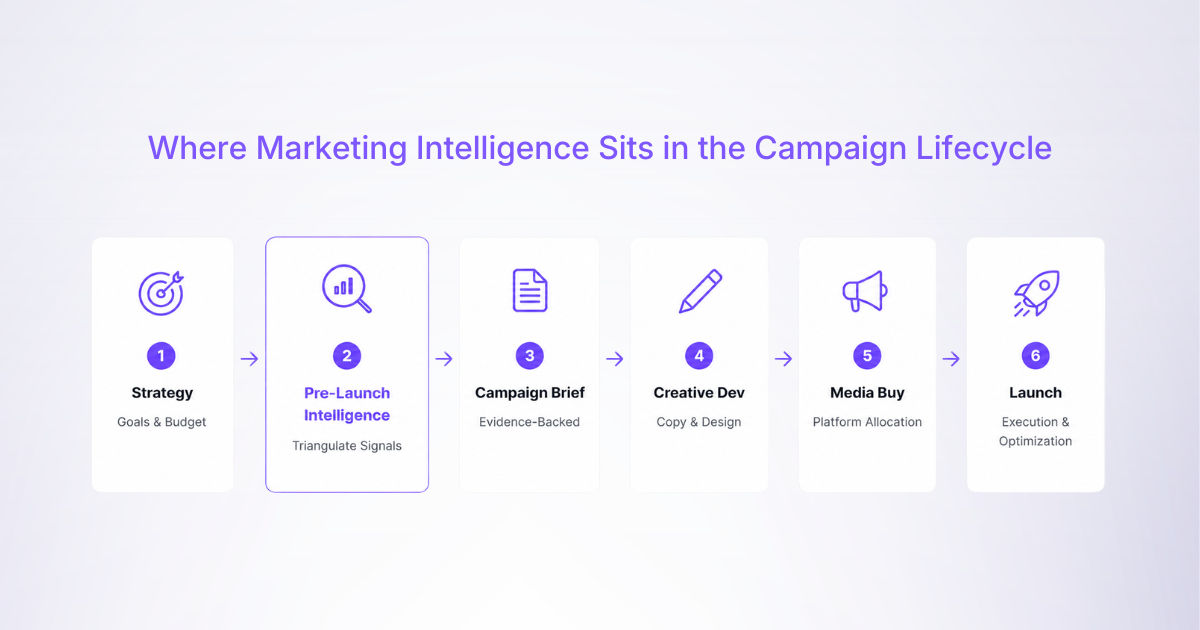
Why Pre-Launch Intelligence Is the Most Overlooked Phase in Performance Marketing
Pre-launch intelligence fails to get investment for one consistent reason: it is invisible when it works. When a campaign performs, teams credit the creative or the media buyer. When it fails, they blame the execution. The research phase, or its absence, rarely gets examined.
This is a structural mistake with measurable costs. Audience alignment and messaging mismatch remain primary drivers of campaign underperformance, not poor creative execution, wrong channel choice, or bad timing. Messaging mismatch is fundamentally a brief-stage failure, which means it is a marketing intelligence and planning problem.
The industry trend is accelerating the need: Search demand for AI-assisted marketing intelligence tools is growing at an extraordinary rate. The keyword ‘AI Marketing Platform’ alone has seen a 740% year-over-year increase indicating that practitioners are actively seeking systematic solutions, not ad-hoc research processes. The category is forming in real time.
What happens when you skip it:
You brief based on assumptions about what your audience cares about, not what they search, ask, and complain about in forums.
You enter an ad category without knowing which competitor angles are saturated, and which are unclaimed.
You allocate budget to a platform where your category buyers do not convert.
What becomes possible when you get it right:
Briefs that have a clear, evidence-backed claim for why a specific angle will resonate with a specific audience at a specific stage of intent.
Creatives that mirror the language your buyers use, not your marketing team's language.
Platform allocation decisions that are based on where your audience converts, not where everyone else is advertising.
The single biggest opportunity here: most teams research audiences, competitors or platform. Almost nobody synthesizes all three simultaneously.
The 5 Core Signal Sources Every Marketer Must Triangulate
Marketing intelligence is only reliable when it draws from multiple signal categories at once. A single-source analysis containing only competitor or search data creates dangerous blind spots. The five signal categories below form the foundation of an effective intelligence stack. Each helps answer a different question marketers need to address before launching a campaign.
Competitor Signal
Why is this important: Competitor ad intelligence tells you the creative landscape your campaign is entering. This includes active ad angles, platforms and format, estimated ad-spends, messaging hooks, offer structures, and landing page patterns. Critically, it also tells you which angles competitors have abandoned, a signal that something underperformed.
Information source: Meta Ad Library (free), Google Ads Transparency Center (free), ad spy tools (SimilarWeb, SpyFu), and direct SERP monitoring for branded search terms.
Common mistake: Copying what competitors are in market with. The more useful signal is what they stopped doing, because that points to what failed, and what may have been prematurely abandoned.
Audience Signal
Why is this important: Audience intelligence goes beyond static personas. It tracks live behavioral signals: what buyers are searching for, what questions they are asking in communities, and what problems they are describing in their own words, not your marketing team's assumptions.
Information source: Reddit threads, G2/Capterra reviews, People Also Ask results on Google, YouTube comment sections, niche community forums.
Search Demand Signal
Why is this important: Where is intent building, softening, or shifting in my category? Search data reveals the volume and momentum of buyer intent at each stage of the funnel. It tells you which problems buyers are trying to solve and what language they use at each stage (awareness vs. consideration vs. decision).
Information source: Google Search Console (owned traffic), Google Keyword Planner, Semrush, Ahrefs, and trend monitoring tools.
Platform Signal
Why is this important: Where does my category's audience actually convert, not just browse? Platform intelligence identifies which channels have the highest concentration of in-market buyers for your specific category, and what creative format performs in those contexts. This is distinct from general platform demographics, it is category-specific conversion data.
Information source: SimilarWeb audience overlap reports, platform-specific ad benchmarks (Meta, Google, LinkedIn), industry benchmark reports from agencies.
Macro Trend Signal
Why is this important: What cultural, seasonal, or market-level forces are affecting timing and framing? Macro signals tell you whether the market is moving toward or away from a category, whether cultural events are creating tailwinds or headwinds, and whether the timing of a campaign launch is working with or against external forces.
Information source: Google Trends, industry publication editorial calendars, social listening tools, economic and sector reports.
According to McKinsey & Company's B2B Pulse 2024, data-driven commercial teams achieve a 1.7x higher likelihood of increasing market share than their peers, yet most performance marketing teams fall short in systematically triangulating multiple signal categories.
How AI for Market Research Changes the Intelligence Workflow
AI for market research does not replace the intelligence process. It compresses it. A traditional pre-campaign research cycle includes pulling competitor ads, mapping audience language, analyzing search demand, reviewing platform benchmarks, and scanning macro trends. This takes days when done manually across separate tools. AI compresses that to hours or even minutes by automating data aggregation, pattern detection, and initial synthesis across sources that previously required separate logins, separate exports, and manual cross-referencing.
What AI does well in the research workflow:
Aggregation: Simultaneously pulling structured data from multiple sources without manual switching
Pattern detection: Identifying recurring themes across competitor ads, audience language, and search queries
Clustering: Grouping related signals into themes that a human would have to manually categorize
Summarization: Distilling large volumes of raw data into structured outputs a marketer can act on
What AI does not replace:
Judgment on brand fit: Whether a specific angle fits your brand's positioning and risk tolerance
Cultural nuance: Whether a creative approach lands correctly in a specific market or demographic context
Creative risk-taking: The decision to run a contrarian or unexpected angle that data alone would not suggest
HubSpot's State of Marketing 2026 report found that 61% of marketers believe that marketing is experiencing its biggest disruption in 20 years due to AI. This structural shift is driving marketing organizations to integrate tools that automate raw data aggregation so they can focus human effort on high-value synthesis.
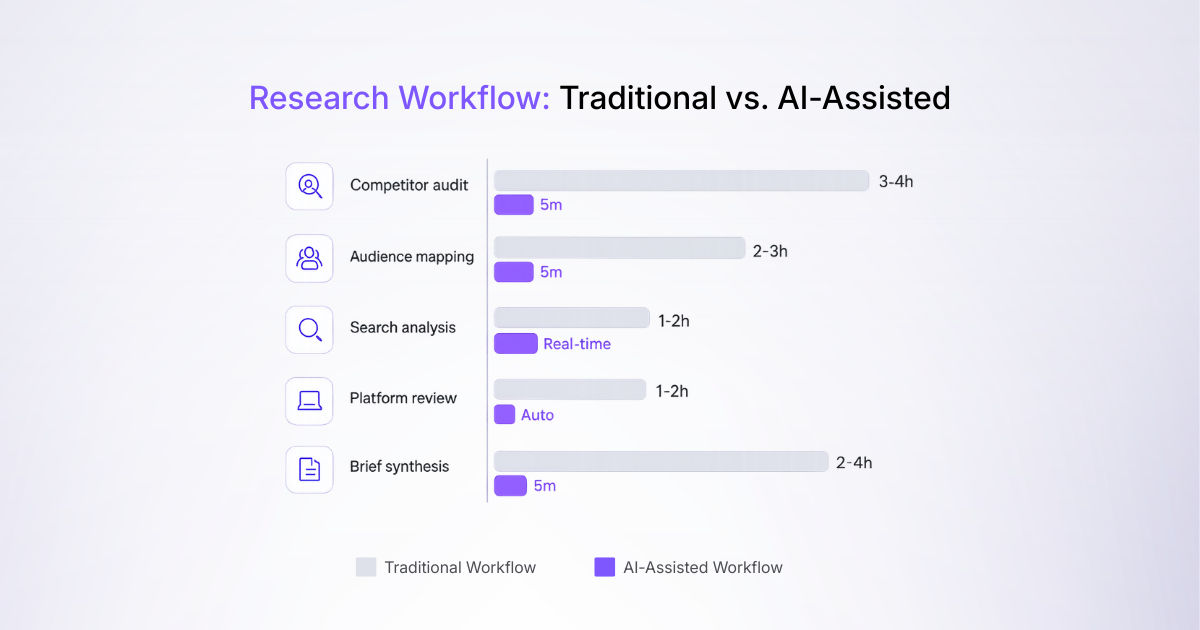
The old workflow vs. the AI-assisted workflow:
Step | Old Workflow | AI-Assisted Workflow |
Competitor ad audit | 3–4 hours manual review | 5 minutes with aggregated output |
Audience language mapping | 2–3 hours across Reddit, reviews, forums | 5 minutes with clustered themes |
Search demand analysis | 1–2 hours keyword research | Real-time signal with trend data |
Platform benchmark review | 1–2 hours report pulling | Integrated into brief automatically |
Brief synthesis | 2–4 hours writing and formatting | Structured brief generated from synthesized data |
Total time | 9–15 hours across 5+ tools | 10-15 minutes in one workspace |
This is the structural shift that market research AI tools are enabling. They do not eliminate the human judgment layer, but eliminate the manual data-wrangling layer that sits underneath it.
Tools and Resources
The starting point for structured marketing intelligence is not a single tool, it is the decision to treat intelligence as a systematic phase with defined inputs and outputs, not an ad-hoc research session.
Recommended tools by signal category:
Signal Category | Tool | What You Get | Cost |
Full intelligence synthesis | Torpian |
| From $59/month |
Competitor ad intelligence | Meta Ad Library |
| Free |
Competitor ad intelligence | Google Ads Transparency Center |
| Free |
Search demand | Google Search Console |
| Free |
Search demand | Semrush |
| Freemium |
Audience language | Reddit (manual research) |
| Free |
Audience language | G2 / Capterra |
| Free |
Platform intelligence | SimilarWeb |
| Freemium |
Honest assessment: The free tools above give you the raw signals. The challenge is not access, it is what comes after. Manually pulling data from 6–8 tools, identifying the right strategy, and then building creatives across separate platforms takes ~20 hours. Torpian connects that entire value chain, intelligence, audience insights, campaign strategy, and launch ready creatives in one workspace, at a fraction of time and cost.
Getting Started: Your First Marketing Intelligence Session
Your first structured marketing intelligence session should take no more than 2 hours and produce one clear output: a brief with at least two signal sources cited for each major claim.
Step 1: Define your five signal categories (10 minutes) Before pulling any data, write down one specific question for each signal category:
Competitor: What is the dominant creative angle in our category right now?
Audience: What exact phrase do buyers use when describing their core frustration?
Search: What problem-focused keywords are growing fastest in our category?
Platform: Which platform has the lowest CPM for in-market buyers in our category?
Macro: Is there a seasonal or cultural signal affecting our campaign timing?
Step 2: Pull at least two sources per category (60–90 minutes) Do not rely on a single source per category. Run at least two data pulls per signal type to enable cross-referencing. This is where the cluster and validation stages of the Triangulation Methodology begin.
Step 3: Synthesize into a brief (20–30 minutes) Write one brief section per validated theme. Each section should state: (a) the claim, (b) the signal category it came from, and (c) at least two sources that support it. If a claim cannot be sourced to two categories, mark it as a hypothesis.
The most common hesitation at this stage is "I don't have enough data yet". Structured intelligence from even two sources per category is more reliable than a brief written entirely from internal assumptions. Start now with what you can pull in 90 minutes, or if you want to compress that further, use Torpian. It combines 15+ data sources and best AI models to surface pre-launch marketing intelligence in minutes.
Frequently Asked Questions
How is marketing intelligence different from market research? Market research is broad and strategic. It informs product decisions and category positioning over months using surveys, focus groups, and longitudinal studies. Marketing intelligence is fast and tactical, it informs campaign briefs using live behavioral data that can be pulled and synthesized in hours. Both are valuable; they operate at different timescales.
How do I use AI for market research? AI for market research works best as a synthesis layer, not a replacement for signal collection. Use AI tools to aggregate data from multiple sources simultaneously, cluster related signals into themes, and generate structured brief outputs. The most effective workflow combines AI-assisted aggregation with human judgment for brand fit and creative risk assessment.
What is market research AI and how accurate is it? Market research AI tools use large language models and structured data pipelines to aggregate and interpret signals from competitor ads, search trends, community discussions, and platform benchmarks. Accuracy depends on the quality and diversity of input sources. Tools that pull from a single source produce single-source bias. Tools that triangulate across 10+ sources produce significantly more reliable outputs.
How long does pre-launch marketing intelligence take? A structured first session takes 10-15 minutes with the right tooling, or 20 hours manually across separate tools. The goal is not exhaustive research; it is confident evidence for your most critical brief claims. Even a 15-minute intelligence session that covers competitor, audience, and search signals produces a meaningfully stronger brief than one written from internal assumptions alone.
What are the most important signals to track before launching a campaign? The five minimum signal categories are: competitor ad intelligence (what rivals are running and stopping), audience language (exact words buyers use to describe their problem), search demand (which keywords are growing and which are softening), platform performance (where your category converts, not just where your audience exists), and macro trends (cultural and seasonal signals affecting timing). Triangulating across all five eliminates the most expensive campaign brief assumptions.
Is marketing intelligence only for large teams with big budgets? No. The core tools: Meta Ad Library, Google Ads Transparency Center, Reddit, G2 reviews, Google Search Console, are all free. The investment is time and process discipline, not budget. A solo founder spending 2 structured hours on intelligence before launching a campaign will consistently outperform teams that launch on intuition, regardless of team size or spend level.